Saturday Garden Work

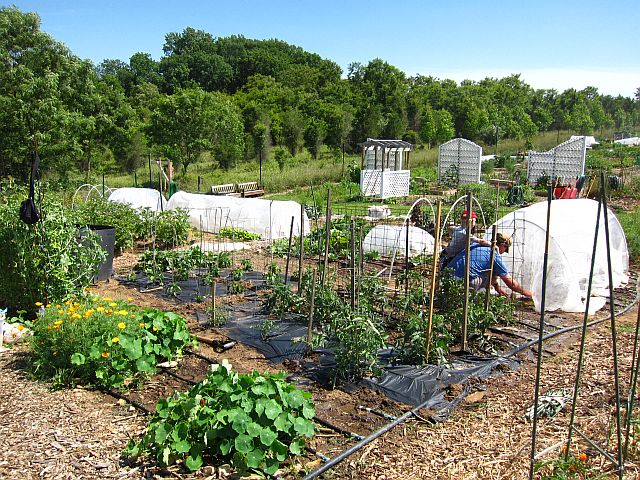
We worked hard in our garden plot today, installing drip system, fertilizing plants, saving the eggplants, laying down microperforated mulch (looks like black plastic), planting cucumber seeds and picking sugar snap peas.

  • My husband installed the drip system.  He only had to purchase new drip tape and caps. All the other parts we reused from last year’s system.
  • The eggplants needed to be saved because when we arrived at the plot, the row covers were blown off  and the eggplants were freckled with flea beetle bites.  We sprayed them with Pyrethin and gave them a boast with fish emulsion fertilizer.  We only covered half of them with the row covers, since some were already flowering.
  • I fertilized the peppers and tomatoes with Garden Tone.
  • We put down BioTelo (since our community garden does not permit black plastic to be used) around some of the tomato plants and all of the pepper plants.  BioTelo is biodegradable and compostable.  It stops weeds, warms the soil and reduces water evaporation.  Ideally, it should be place on the ground before planting.

The main garden lesson we learned today –  in March, work soybean meal fertilizer into the soil, put down the drip tape and cover it with black plastic or BioTelo.  That allows two months for the soil to warm up and kill off the flea beetles that over winter in the ground.  The ground will be ready in May and June for planting summer crops.
Drip System in Our Plot

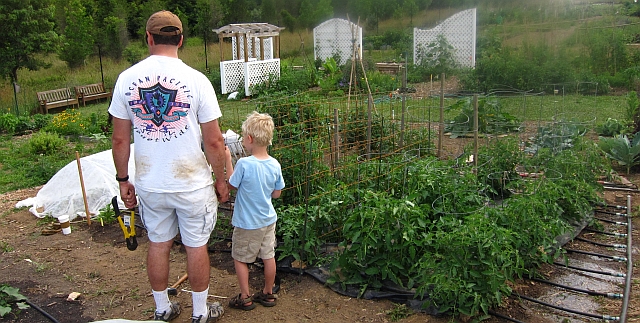
a partial view of our new drip system in the tomato bed

My husband installed a drip system in our garden plot.  The long black tubes looked too industrial for me at first.  But when the drip system watered the plot while I planted seeds, weeded the beds, cut the swiss chard crops, removed tomato suckers, photographed garden flowers and bugs, and played with my son,  I came to appreciate the contrast of black plastic stripes against green foliage and brown dirt.   The drip system is awesome!  It saves time and water.

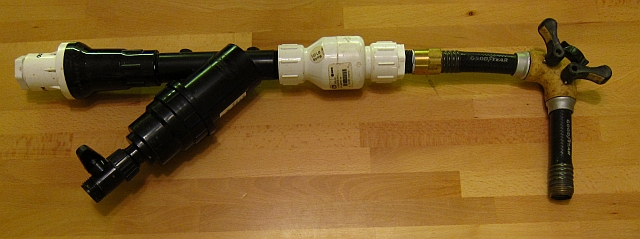
After consulting with a local master gardener, my husband ordered drip system supplies from Robert Marvel.   It took him about 2 hours to completely set up the system. The system has these basic parts:   a removable assembly (consisting of a check valve, filter and pressure regulator), a distribution tube, drip tape and a garden hose.

removable assembly part not seen in photo
the removable assembly

To water the garden, all I do is hook up our hose to the community garden water spigot and the removable assembly attached to the distribution tube (thick tube seen in photo at edge of plot).  Water flows out from the distribution tube to the drip tape between the plants.  The drip tape has emitter holes every 8 inches and delivers .53 gallons of water/minute/100 feet of drip tape.  Our garden plot needs one inch of water per week thus the drip system needs to run for a total of two hours a week.

The initial cost of installing a drip system is not cheap, but the benefits are worth it.   Drip irrigation is the most efficient way to water plants.  It delivers water directly to plant roots where the most water absorption takes place thus prevents water run off.  It eliminates water on plant foliage thus reduces risk of diseases and water evaporation.   The cost of all the parts for a drip system is around $100, but most of the parts last for many years.  Drip tape costs 3 cents a foot and is the only part that needs to be purchased each season.

Thanks to my husband for the drip system! It allows me more creative free time in our garden plot!